
Am I overscheduled or just poorly organized?

I optimistically started blogging at the start of the year. But less than three months into my new endeavor, more than one something had to give, and I abandoned my newest activities, both writing and reading other bloggers, as well all social media. I’m still trying to find a way to balance everything, and at this moment, I’m wondering what the hell I was thinking.
“In real life,” I am a CPA/income tax manager, which requires intensely busy workdays and too much overtime for two months each spring and fall. I knew this when I set up my Twitter and Medium accounts and website and started writing. I budgeted my time accordingly, carving out a half hour five days a week, and wrote a few pieces in advance to post throughout the spring so as not to disappear if my plan didn’t work out.
And then life blew up, and even my backup plan didn’t work out.
It is now May 31, a full seven weeks after my work overtime ended, and I’m only just now able to think about writing and reading and interacting again, so I’m trying to figure out whether my inability to stick to my plan this spring will be an anomaly or my expectations were unrealistic.
Work itself was part of it. My firm touts its focus on well-being and work-life balance—admirable goals, and it’s not just lip service. But both have been elusive to many of us simply because there aren’t enough of us. Turnover is high, and those who stay are burning out. Over the last few years, leadership has implemented a grand plan which realigns teams, reassigns workloads, and redesigns or automates some processes and procedures for equity and greater efficiency.
I see the big picture and understand how it should help. But in practice, human beings resist change, and even those who embrace it get confused and fall back on old habits. This spring, complaints mounted, morale suffered, and I found myself holding hands that aren’t mine to hold anymore, taking calls which should have gone to others, and listening to people gripe, which left less time for my own work and caused me longer hours.
Part of this was on me. I like to be approachable and pride myself on great rapport with my colleagues and clients, but I need to set firmer boundaries and more assertively guard my time.
My personal life was a bigger problem, and so much that needed my attention/action felt out of my control.
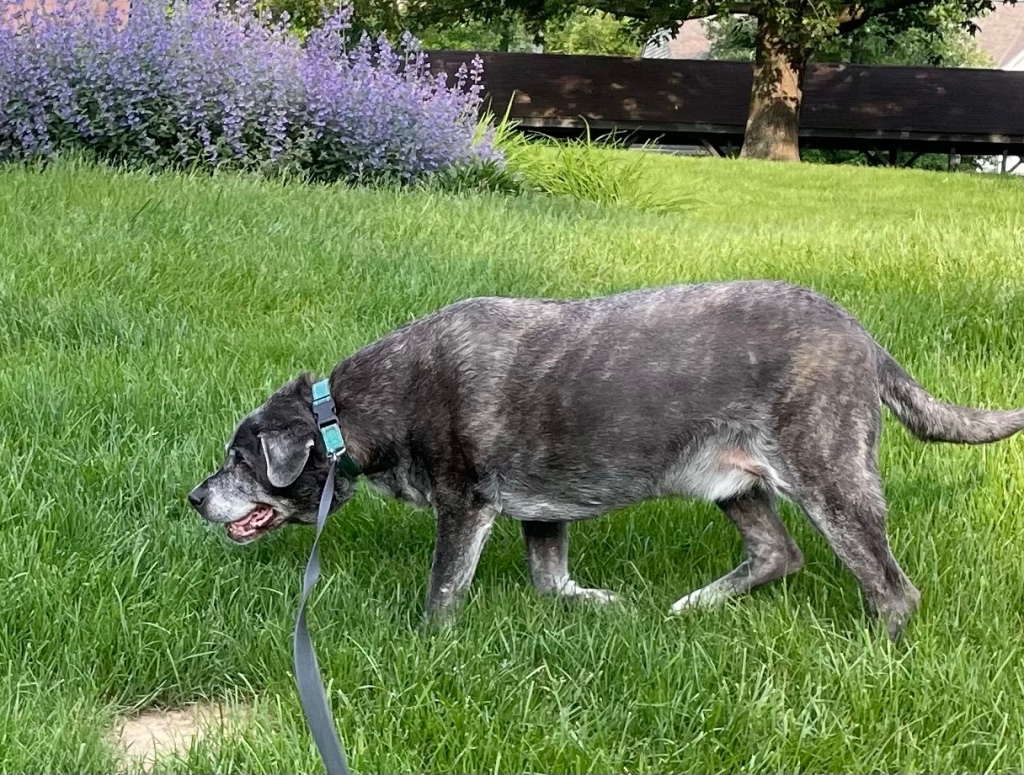
In early March, my dog Buddy developed an autoimmune disorder (masticatory myositis), and his jaw muscles froze shut. But the standard treatment, heavy doses of prednisone to suppress the inflammation and his immune system, was almost as bad for him as the disease.
I didn’t understand this—when I’m on prednisone, I feel like superwoman! But his muscles atrophied to the point he could barely walk, and he was leaving puddles of urine and diarrhea on the kitchen floor two or three times a night. The vet switched his meds, but we had to wean him off the prednisone way more slowly than we’d have liked, and the new med caused nausea until he got used to it, so he stopped eating and drinking and became so listless I was sure it was the end.
I had to sleep on the couch for several weeks, both because he could no longer climb the stairs up to the bedroom and because he needed to go out so frequently. So, I didn’t sleep much or well, which made work even harder at the apex of peak season since my brain wasn’t functioning on all cylinders. *
During all this, my aunt fell, spent a week in the hospital, and passed away in late March. My uncle, her brother, had a heart attack a few weeks later and is still not out of the woods. These are my dad’s siblings, and he’s been gone for over twenty years, and they are like surrogate parents and my cousins more like siblings, so it’s been tough.
Some good things happened too, but they still required time and energy.
We had two family weddings between March and this week, preceded by two bridal showers. Another aunt turned 75, and we threw her a surprise party, which required a lot of stealth maneuvering to obtain old pictures of her since she is the primary keeper of the family photos. We also expended a lot of mental energy to keep our mouths shut at the afore-mentioned showers and weddings!
Social Security finally approved my brother Dan for disability pay after a two-year fight, and he received a huge lump sum of back pay in February. But because of this, he no longer qualified for the Medicaid that was paying for his health insurance and his nursing home (he’s been in skilled nursing care since being diagnosed with vascular dementia nearly three years ago).
But he also suddenly had enough money to private pay at an assisted living facility for at least a year before he’ll need Medicaid again, and he was convinced he could live on his own again, with a little help. He desperately wanted to live in his own space again rather than a shared hospital room, and I wanted that for him too, but I was concerned he couldn’t handle it (and, frankly, that I would end up needing to do even more for him).
Dan’s primary issue is short-term memory impairment, so learning a new facility, new routines, and new people will take him much longer than it would have before the dementia; his nursing home caretakers were concerned he would be isolated, confused, and depressed, which would hasten his deterioration.
But he’s compensating much better than he did at the beginning, and I felt he deserved a chance at regaining as much independence and privacy as he can handle for as long as he can handle it. So, we had several care conferences and assessments over three months with his nursing home team and the admissions folks at the assisted living facility to determine whether the move was advisable.
We did move him, but he’d lost almost all of his possessions three years ago when he was evicted while in the hospital, so we had to acquire and move all the usual furniture and household items you need to outfit an apartment. He finally settled in two weeks ago. **
And, my daughter, a digital nomad for the last eighteen months, rented an apartment nearby (she had been certain she would eventually land back in her college town, so I credit the dog for her change of heart!). Still in her twenties and unaccustomed to making huge financial commitments on her own, she asked me to help her tour possible places and shop for new furniture (if only we could have seen the future, I could have equipped my brother’s apartment with her cast-offs, but on her last move, she had finally junked the hand-me-downs she’d schlepped across the country several times since college).
She moved into the new place two weeks ago right as we were also moving my brother, and I’ve been going back and forth to both places to help unpack and assemble things.
It’s been a busy spring.
Or am I just making excuses?
I don’t know. But with four months out of the year insane because of work, and personal obligations filling the off-seasons, I’m wondering whether there’s any way I’ll be able to more than dabble in writing until I retire and/or the people and animals I take care of are gone.
If I were a “real writer,” could I make it work no matter what?
Am I not prioritizing or budgeting my time properly?
That feels unfair; I really did have a lot going on. But life is going to continue clamoring for my attention. How do I make time for writing?
Maybe after I recuperate from the recent chaos, I’ll find a helpful perspective.
*Buddy is doing much better now, thank goodness! He’s still weaker and slower than he was three months ago, but he’s finally off the prednisone as of this week, and his spirit is back. He’s playing with toys again, trotting occasionally on his walks, and climbing steps and pulling at the leash without falling over. He’ll be 10 years old soon, and I know he won’t live forever, but we hope he has a few good years left.
**My brother Dan is also doing well in his new place! It helped that, in a stroke of fantastic timing, his best buddy since childhood (really more of a sibling to him than I am) was already scheduled off work these past two weeks and has been over several times to hang out with him and help configure his new man cave. They are both thrilled!

 V Lynn Connelly